


Brief Overview:
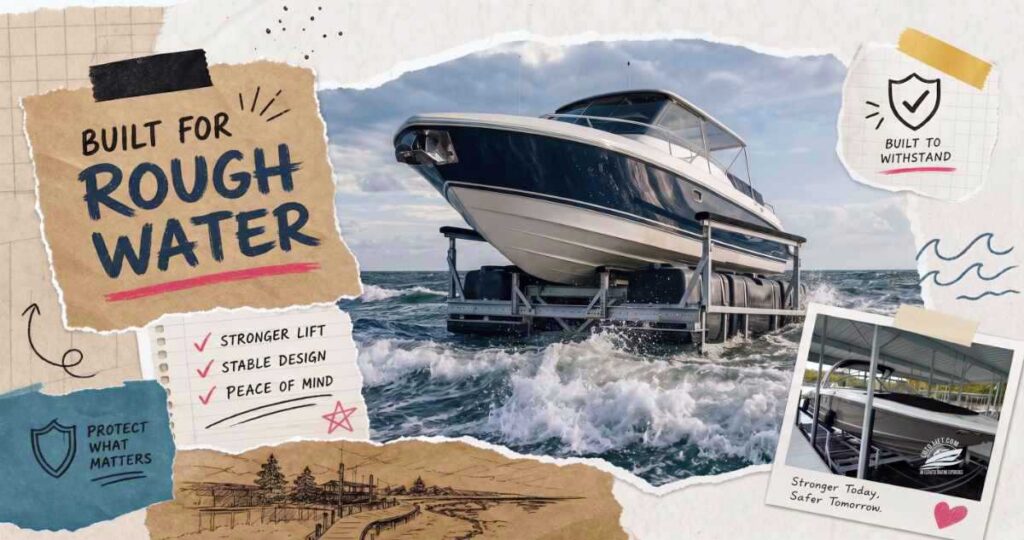
The best boat lift for rough water is a floating pneumatic lift with a wide tank footprint, enough vertical travel to clear peak wakes, and all structural steel above the waterline. Fixed and standard hydraulic lifts fight the wave. Floating lifts ride it. At Lake of the Ozarks, that difference shows up as less hull rub, less frame fatigue, and far less corrosion. LOTO Lift’s LT Model side-mount was built for that exact job.
What is the best boat lift for rough water conditions? It’s one of the most important questions a lake property owner can ask, and the answer isn’t about finding the biggest unit or spending the most money. It’s about matching the lift’s design to how your water actually behaves. Waves don’t care what you paid for your lift. Wakes from passing boats don’t check whether your frame is rated for surge. A hard storm season at a wave-prone lake has a way of exposing every design flaw that flat, calm water never revealed.
Owners on lakes with serious wave action have been learning this lesson the hard way for decades. At Lake of the Ozarks, where boat traffic is heavy and open-water exposure creates a real surge in certain coves and channels, the feedback loop between lift design and real-world conditions is short. What works, holds up. What doesn’t, fails fast. The patterns that emerge from environments like that reveal exactly which features separate a lift that performs from one that becomes a liability.
By the end of this article, you’ll know which lift type suits your specific conditions, which specs to demand before signing anything, and what installation looks like before you call anyone for a quote.

Why the Wrong Lift Type Fails in Rough Water
Fixed Lifts and the Wave Action Problem
Fixed-mount lifts and standard hydraulic systems are engineered for predictable, calm-water environments. The core assumption built into their design is that the water stays relatively still and the lift doesn’t need to move with it. In wave action, that assumption fails. Instead of absorbing surge energy, these lifts resist it, and that energy gets transferred directly into the boat hull and the lift frame. The result, over time, is bracket fatigue, frame bending, and hull contact during surge events that gradually damage both the vessel and the structure holding it.
The problem compounds because fixed lifts attach rigidly to pilings or concrete structures. When a wave passes through, the dock may flex slightly, but the lift doesn’t. That mismatch creates stress at every connection point. Owners who run fixed lifts in rough-water slips commonly encounter cracked welds, bent cradle arms, and hull rub marks that didn’t exist when the lift was new, failure modes consistent with the cyclical loading that fixed systems are not engineered to handle.
If you want a clearer picture of how boat lifts work, the types, and why they matter, start there before you compare spec sheets. The type you choose matters more than the brand name on the tank.
What "Rough Water" Actually Means at the Dock
Rough water isn’t exclusive to coastal environments. On inland lakes, rough conditions come from a combination of wind fetch, open-water exposure, and boat traffic. A slip positioned at the mouth of a cove on a busy lake can experience frequent wake events during peak season. Storm fetch, where wind drives waves across a long stretch of open water toward your dock, can generate a surge that rivals conditions most people associate only with ocean environments.
If your dock sits in a wake corridor, faces open water, or experiences consistent afternoon wind chop, you’re dealing with rough water. The lift you choose needs to be built with that reality in mind, not designed for the calm-water scenario that looks good in a brochure. That’s the truth about floating boat lifts in rough water: leaving a boat tied in the slip is not the same thing as protecting it.

What Is the Best Boat Lift for Rough Water Conditions? Key Features Compared
Hull Clearance and Lift Travel Height
In rough water, the goal isn’t just clearing the average waterline. The boat needs to clear the peak wave height as well. Lift travel refers to the total vertical distance the cradle moves between its lowest and highest positions.
In high-wake environments, prioritize lifts with approximately 60 inches or more of vertical travel. That elevation generally keeps the hull above surge during storm events on many wake-prone sites, though the exact travel you need depends on your local maximum wave and wake heights, and on site-specific conditions. Lifts with limited travel leave the hull dangerously close to the waterline when conditions deteriorate.
Tank Footprint and Buoyancy Stability
A wider tank footprint increases transverse stability, improving the righting moment, and reduces side-to-side rocking during wave action. Think of it the same way you’d think about a wide-hulled boat versus a narrow one: the wider the stance, the more stable the platform. This matters especially for wide-beam boats like pontoons and tritoons, where a narrow-footprint lift creates a rocking instability that gets dramatically worse in surge. For wide-beam vessels, tank footprint isn’t optional; it’s load-bearing.
If your slip is extra wide or you run a big toon, look at wide slip boat lifts at Lake of the Ozarks next. Stability in a wide slip and stability in rough water are two sides of the same problem.
Frame Design and Corrosion-Resistant Materials
Rough water accelerates corrosion by constantly refreshing the contact zone between water and metal. On a calm-water lift, a submerged steel component might sit in relatively still water. In wave action, that same component gets turbulent water pushed across it repeatedly, stripping away any protective layer and accelerating oxidation. The most effective solution isn’t a better coating on steel, it’s keeping steel out of the water entirely. Poly tank systems, sometimes called hydropneumatic systems, that keep all structural metal above the waterline eliminate this problem at the source rather than managing it after the fact.
This is what “steel out of the water” looks like on an LT Model — no submerged frame sitting in chop all season.
Floating Pneumatic Lifts vs. Fixed Alternatives in Choppy Conditions
How Floating Pneumatic Systems Handle Wave Energy
The core mechanical advantage of a floating pneumatic lift is straightforward: it moves with the water instead of against it. As wave energy passes through the dock, the lift rises and falls naturally with the surface. The hull stays in the cradle, the cradle stays level with the water, and the surge passes through the system without being transferred into the boat. Fixed lifts can’t do this. They hold position while the water moves, which means every wave becomes a loading event on the frame and the hull.
This isn’t a minor performance difference. Over a full season on a rough-water lake, cumulative surge events place significant structural stress on a fixed lift, stress that compounds over time and eventually shows up as visible frame damage. A floating system absorbs that energy continuously and distributes it through buoyancy rather than frame stress, which is why storm-proof boat lift designs almost universally rely on floating or self-adjusting platforms.
If you’ve ever wondered how a floating boat lift works in plain language: air goes into the tanks, the lift rises, air vents out, the lift settles. The important part for rough water is that the whole platform is free to follow the surface instead of bracing against it.
The Steel-in-Water Problem in Rough Conditions
Rough water doesn’t just stress lift frames physically, it accelerates corrosion by constantly refreshing the water-to-metal contact zone. Pneumatic lifts built with roto-molded poly tanks address this directly: the steel frame doesn’t sit submerged, which eliminates electrolytic corrosion and reduces long-term structural degradation from water exposure. This is both a performance advantage and a maintenance advantage.
A poly tank system’s annual upkeep focuses on mechanical inspection, pneumatic system checks, and hardware above the waterline. Steel-in-water fixed systems in rough-water environments face higher annual maintenance costs because accelerated corrosion cycles require more frequent inspection, coating renewal, and component replacement. Evaluated over a 10-year ownership horizon, the difference in ongoing maintenance costs between a poly tank system and a steel-in-water fixed lift can be substantial.
That’s a big reason why so many LOTO boaters prefer using a boat lift in the first place: the boat stays dry, the steel stays out of the water, and the weekend is spent on the lake instead of on repairs.

Purpose-Built Design vs. Off-the-Shelf Options: Why It Matters
When Generic Lift Designs Reach Their Limits
Most boat lifts on the market are designed for average conditions: moderate wake, predictable water depth, protected slips with minimal surge exposure. Those lifts perform adequately in the environments they were designed for. When they get installed in rough-water conditions, they underperform because the design assumptions don’t match the reality. “Purpose-built” means the engineering started with a specific set of conditions and worked outward from there, rather than starting with a generic design and hoping it holds up.
The difference typically shows up in real-world performance relatively quickly. Generic lifts installed in rough-water environments can develop frame stress, tank positioning issues, and hull contact problems that the manufacturer never anticipated, because they never designed for those conditions. Once structural damage sets in, repair options are limited and replacement often becomes the only practical path forward.
The LOTO Lift LT Model: Built for Rough-Water Performance
LOTO Lift’s LT model is a strong answer to the question of what is the best boat lift for rough water conditions. Developed for the demanding wave environment at Lake of the Ozarks, a site with high boat traffic volume, significant fetch exposure, and notable water level fluctuation, the LT’s engineering reflects the specific stresses that rough inland water places on lift systems.
Three features define the LT model’s rough-water capability:
- Upgradeable weight capacity: The lift grows with the owner’s boat, eliminating the need for full replacement when you upgrade to a heavier vessel.
- Parallel poly tank system: All structural steel stays above the waterline, eliminating submerged corrosion and reducing long-term maintenance costs.
- Floating design: The lift absorbs surge rather than fighting it, protecting the hull and the frame during wave events across every season.
Other manufacturers offer rough-water lift products. What sets LOTO Lift apart is a design background rooted in one of the more demanding inland lake environments in the country, with refinements driven by real-world feedback from that specific site. For buyers evaluating rough-water options, that context is worth factoring into the comparison.
See the LT Model on Lake of the Ozarks water — built to keep the hull dry when the wakes roll through.
Choosing the Best Boat Lift for Rough Water Conditions: Anchoring and Installation
Anchor Scope, Dock Connections, and Why Rough Water Demands More
Calm-water dock installations for boat lifts typically anchor with scope ratios between 3:1 and 5:1, meaning the anchor line is 3 to 5 times the water depth. In rough water, that’s not enough. Wave-induced drag and surge loading require scope ratios between 7:1 and 10:1 to prevent anchor dragging under storm conditions. A 10,000-pound lift may require over 1,000 pounds of anchor holding force during a severe weather event, even if it sits stable on a calm day. The anchor system needs to be sized for that worst-case scenario, not the average afternoon.
Rough-water installations also require heavier connections between the lift and the dock structure. Where a calm-water install might use standard dock hardware, a rough-water site needs reinforced attachment points that can absorb the lateral loading created by wave action without fatigue failure over time.
Site Assessment and Permit Basics
Before committing to any model or anchor design, a pre-installation site assessment should cover water depth at the dock, wave exposure direction, bottom substrate for anchor footing, and the condition of existing pilings. Shallow bottom or soft substrate changes the anchor design entirely. Exposed wave approach angles affect where the lift should be positioned within the slip.
At Lake of the Ozarks, all new boat lifts require a Shoreline Management Permit from Ameren Missouri. If the lift includes electrical service, a separate electrical permit from your local fire protection district is also required. Lifts positioned lakeward of elevation 658.5 feet may additionally require a U.S. Army Corps of Engineers permit under the coordinated GP-38M process. Based on Ameren’s published permit fee schedule, the fee for a new installation is typically around $550, though fees are subject to change and the approval process can affect your timeline. Work with a certified dock builder and start the permit application before you finalize your model selection.
What to Budget for a Rough-Water Boat Lift
Purchase Price and Installation Cost Ranges
Heavy-duty rough-water lifts run from $20,000 to $75,000 or more depending on capacity and design. Systems in the 12,000 to 16,000-pound range typically fall between $20,000 and $38,000 installed. High-capacity systems for large pontoons or cruisers in the 20,000-pound-plus range push toward $35,000 to $70,000. Installation adds $1,000 to $5,000 depending on site complexity, and new pilings, if your existing ones aren’t sufficient, can add another $4,000 to $10,000 to the project total.
Frame those numbers against the potential cost of hull repairs. A single season of hull contact damage on an $80,000 pontoon could easily produce repair bills in the thousands, according to marine service industry estimates. The right lift reduces that risk substantially across years of ownership.
Annual Maintenance and Long-Term Cost of Ownership
Pneumatic floating lifts with poly tank systems require significantly less corrosion management than steel-in-water fixed designs. With no submerged steel, annual maintenance focuses on mechanical inspection, pneumatic system checks, and hardware above the waterline. Steel-in-water systems in rough-water environments face higher annual maintenance costs because accelerated corrosion cycles require more frequent inspection, coating renewal, and component replacement.
Evaluate the total cost of ownership over 10 years, not just the purchase price. A lift that costs less upfront but carries higher annual corrosion management expenses, often $800 to $1,500 or more per year for steel-in-water systems in aggressive conditions, based on typical service provider estimates, can end up costing more over the long run than a poly tank system with lower ongoing maintenance requirements.

The Right Lift Is the One Built for Your Water
So, what is the best boat lift for rough water conditions? The short answer: a floating pneumatic lift with a wide tank footprint, adequate lift travel, and steel kept entirely above the waterline. Fixed and standard hydraulic lifts were designed for calm, predictable conditions, and that mismatch shows up as hull damage, frame fatigue, and accelerated corrosion over time. Floating pneumatic lifts, including vertical boat lift configurations with self-adjusting platforms, solve the problems that generic options leave unaddressed because they work with wave energy instead of against it.
LOTO Lift’s LT model reflects what purpose-built rough-water design looks like in practice: upgradeable capacity, poly tank corrosion protection, and a floating system that absorbs surge rather than transferring it into your hull.
If you’re on a rough-water lake or dealing with an exposed slip, the best next step is a site consultation with someone who knows your specific water conditions.
Frequently Asked Questions
What is the best boat lift for rough water conditions?
A floating pneumatic lift with a wide tank footprint, enough travel height to clear peak wakes, and structural steel kept above the waterline. Fixed lifts resist surge. Floating lifts absorb it.
Why do fixed and hydraulic lifts struggle in chop?
They are built for still water. When a wake hits, the frame stays put and the energy goes into brackets, cradle arms, and the hull.
How much lift travel do I need in a high-wake slip?
Aim for about 60 inches or more of vertical travel so the hull stays above storm and weekend-wake peaks. Exact travel depends on your slip’s exposure.
Do poly tanks really matter in rough water?
Yes. Wave action constantly refreshes water-to-metal contact. Parallel poly tanks keep steel out of the water, which cuts electrolytic corrosion and long-term maintenance.
Is the LOTO Lift LT Model a good rough-water choice?
That’s what it was built for: side-mount, parallel poly tanks, upgradeable capacity, and a floating frame designed around Lake of the Ozarks traffic, fetch, and fluctuating levels.
What anchoring is needed in rough water?
Calm-water 3:1–5:1 scope is often too short. Rough-water installs typically need 7:1–10:1 scope, heavier dock connections, and anchors sized for storm loading—not a calm Tuesday.
Do I need a permit at Lake of the Ozarks?
New lifts generally need an Ameren Missouri Shoreline Management Permit. Electrical service needs a local fire-district permit. Lifts lakeward of elevation 658.5 ft may also need USACE coordination. Start permits before you lock the model.
Wakes at Lake of the Ozarks do not care what the brochure promised. If your slip takes afternoon chop, weekend traffic, or open-water fetch, get a lift built for that water—not a calm-cove design hoping for the best.
Ready to protect your boat the smart way?
Read more from our blog...
Wrap-Around Boat Lifts at Lake of the Ozarks: Amazing Walk-Around Access or Hidden Hassles?
TL;DR: Wrap-around boat lifts add a built-in walkway platform that lets you safely circle your raised boat for hull cleaning, prop checks, and easy covering
Unlock Superior Stability: The Best Wide Slip Boat Lifts at Lake of the Ozarks
TL;DR: LOTO Lift’s wide slip boat lifts at Lake of the Ozarks give you a wider, more stable base with pneumatic tanks that are wider
Should You Hire a Pro for Boat Lift Installation at Lake of the Ozarks?
TL;DR: Yes — hire a pro for most boat lift installations at Lake of the Ozarks. Our guided DIY kits work great on simple docks,
Pingback: Can You Upgrade a Boat Lift to Hold a Heavier Boat? | LOTO Lift
Pingback: What to Look for in a Boat Lift for Heavy Wake at Lake of the Ozarks
Pingback: Floating Boat Lifts for Rough Water: What Holds Up on Missouri Lakes