


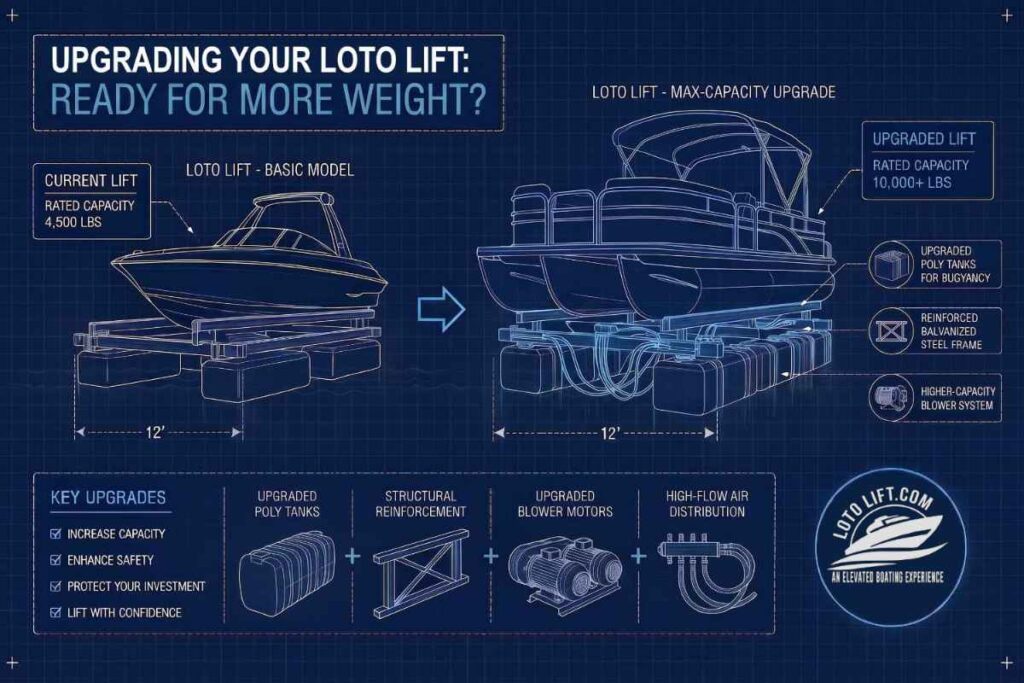
Brief Overview:
- Yes, many LOTO Lift systems can be upgraded for a heavier boat by adding tank frames, tanks, and, when needed, another control unit.
- Start with loaded weight, not the dry-weight number on the spec sheet, then add about 20 percent.
- Example: A 13,500 lb lift and a 17,000 lb lift can be the same platform with one important difference: the middle tank, its frame, and an additional control unit.
- Slip width and boat length decide whether that hardware will even fit and whether the hull stays supported.
- A 17-foot fishing boat to a 36-foot cuddy is not an upgrade. Neither is bolting LOTO tanks onto an old lift from another brand.
If the frame, the slip, or the hull length cannot support the new boat, replacement is the safer and usually cheaper path. Can you upgrade a boat lift to hold a heavier boat? You just put a deposit down on a bigger boat, and now you are standing on the dock, staring at the lift you already own, running the math in your head. It’s a fair question. At Lake of the Ozarks the answer is often yes, but only when the new boat still fits the slip, the hull still sits on a balanced frame, and the capacity jump is the kind a floating lift was built to grow into.
That is a different conversation than the one most generic upgrade articles describe. Those pieces are written for fixed cable lifts: bigger motors, longer cables, snatch blocks, and pilings. A LOTO Lift does not gain capacity that way. It gains capacity by adding buoyancy. More poly tank frames. More tanks. Sometimes another control unit so the lift still comes up even and in a reasonable amount of time.
By the time you finish reading, you will know how to calculate the capacity you actually need, what a real LOTO upgrade changes between sizes like 13,500 lb and 17,000 lb, which slip and hull limits stop the job, and when the honest answer is a new lift instead of a patched one.
Can You Upgrade a Boat Lift to Hold a Heavier Boat? Start with the Right Capacity Number
The dry weight on a brochure is often the wrong starting point. Builders publish dry weight as the base hull with standard equipment. That figure may leave out the outboard, a tower, a second battery, or the full fuel load. If you are not sure the motor is included, ask the dealer, or check published specs on the NADA Guides boat listings, now part of J.D. Power.
The planning formula we walk customers through is simple:
Dry weight + (fuel gallons × 6 lb) + about 500 lb for gear and people = loaded weight.
Gasoline is roughly 6 pounds per gallon. The 500-pound gear allowance covers life jackets, a cooler, water toys, fishing gear, and the odds and ends that collect on a boat over a season. It sounds high until you start adding it up.
A 22-foot recreational pontoon in this market often lands around 2,200 lb dry. A 30-gallon tank is about 180 lb. Add 500 lb for gear and passengers and the loaded weight is about 2,880 lb. That is the number to work from, not the 2,200 on the sheet.
Our boat lift weight capacity guide walks through the same idea: capacity is the maximum safe load of the boat as you actually use it.
Why the 20 Percent Margin Is Not Optional
Once you have loaded weight, multiply by 1.20. That 20 percent buffer is the minimum we want between the boat you launch today and the rating on the lift. Our weight-capacity page actually suggests a 20 to 30 percent cushion, because boats gain weight. A second battery, upgraded speakers, a wakeboard tower, or five years of “it will fit in the storage compartment” all count.
Using the pontoon example: 2,880 lb × 1.20 is about 3,456 lb. Size to the next standard capacity above that number, not down. If you land between two LOTO sizes, take the larger one. Running a lift at its ceiling is how bunks, arms, and tanks end up doing a job they were never given room to do.
What a LOTO Upgrade Actually Changes
On a floating pneumatic lift, capacity is buoyancy. Air goes into rotationally molded poly tanks, water is displaced, and the boat rises. Vent the air and the lift settles. If you want a plain-language walk-through of that cycle, our guide on how a floating boat lift works covers the raise and lower sequence.
Generally, upgrading a LOTO Lift for a heavier boat means increasing buoyancy by adding tank frames and tanks. The valves and control-unit pumps are the same hardware already on the dock. You may simply need more of them so the lift stays even and the cycle time stays reasonable.
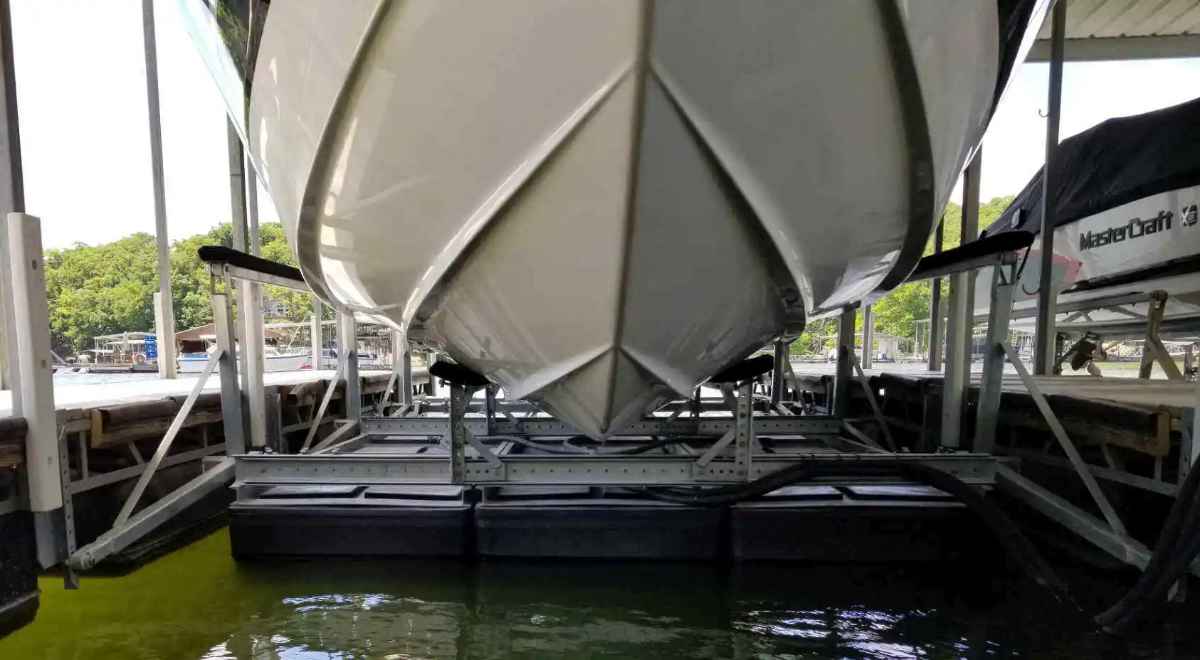
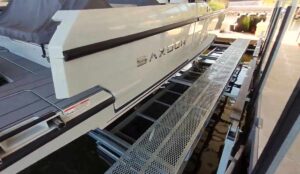
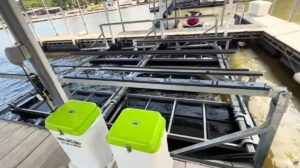
A clean example (see pictures below) is the step from a 13,500 lb lift to a 17,000 lb lift. The only difference between those two sizes is the middle tank, the frame that holds it, and an additional control unit. It’s just more of the same system that creates lift, placed so the boat still comes up level.
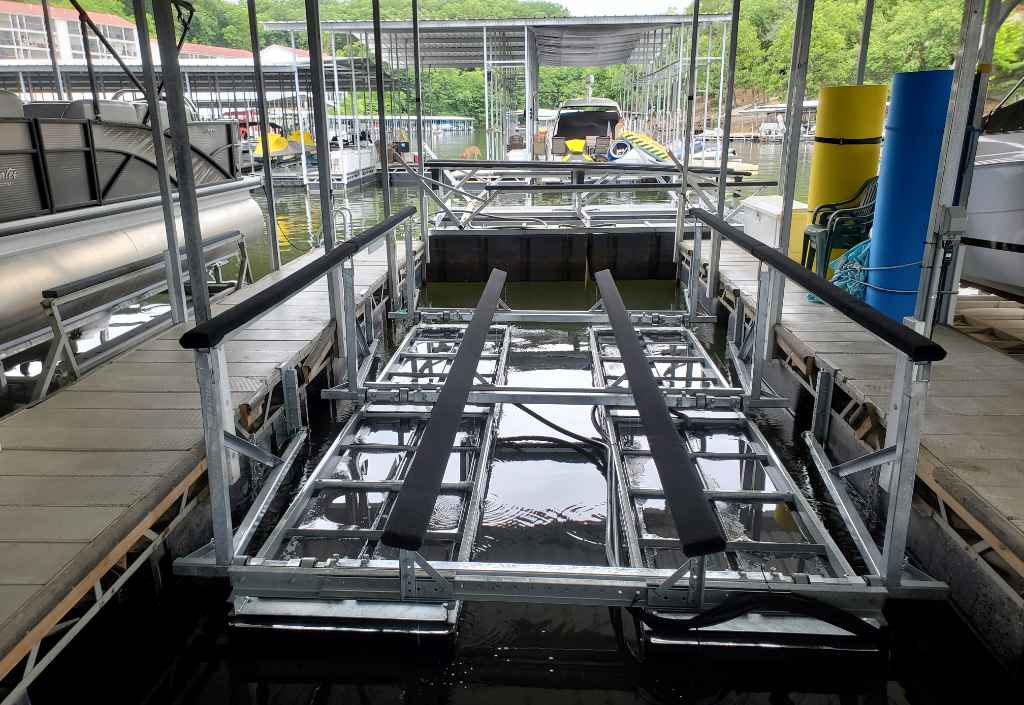
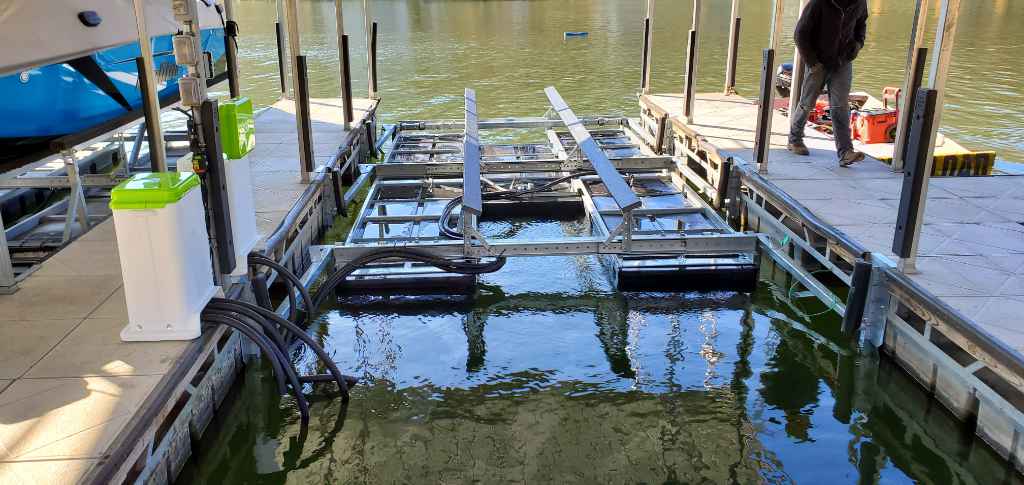
The difference is easy to see. The 13,500 lb lift has tank frames on the port and starboard sides and an open center under the bunks. The 17,000 lb lift enhances that center. A middle tank and its frame sit in the well, hoses run to it, and a second control unit sits on the dock beside the first. That is the upgrade. More buoyancy, and a second control unit motor so the extra tank fills evenly and the cycle does not drag on.
Slip Width and Boat Length Can Stop an Upgrade Cold
Hardware is only half the question. Slip width and the new boat’s length have to be checked before anyone talks about tanks.
Slip width matters because the added frame and tank have to fit somewhere. A middle tank does not hover in empty air. It needs width in the well, clearance at the fingers, and room to travel without kissing a piling, a roof post, or the neighboring slip. Covered docks at the Lake are generous until they are not. A few inches of beam, a swim platform, or a wider set of pontoon logs can use up the space an extra tank frame needed.
Frame length matters just as much. We compare the overall frame to the new boat’s length so the lift stays balanced and the hull is supported, not perched on the middle third while the bow and stern hang. A boat that is too long for the frame teeters. A boat that is much heavier and much longer than the original design is not sitting on an upgrade – it’s sitting on a compromise.

If the slip is already wide and the question is stability rather than a capacity jump, the wide slip boat lift guide is the better starting point. Width and weight are related, but they are not the same problem.
We also give a cursory look at the rest of the system. In rougher portions of the Lake, swapping to heavier-duty arms is sometimes worth doing while the lift is apart. The main channel, a long fetch, and heavy weekend traffic are harder on arms than a protected cove. That is a fit conversation, not an automatic parts upsell. Our piece on the best boat lift for rough water at Lake of the Ozarks explains why the LT platform is built for that chop in the first place.
Two Upgrade Calls We Have to Turn Down
People bring two expectations that sound reasonable on the phone and fall apart at the slip.
The first is a massive change in boat size. Joe calls because he just moved from a 17-foot fishing boat to a 36-foot cuddy and would like to upgrade a 4,000 lb lift to a 14,000 lb lift. There is no way to do that. Even if the buoyancy could be forced, the boat would be teetering, unsafe, and unsupported. The frame was never long enough, the slip was never wide enough, and the arms were never meant to carry that hull. That job is a new lift, sized to the cuddy, not a rebuild of the bass-boat hoist.
The second is a brand mix. Joe went from a pontoon to a tritoon that weighs 1,500 lb more and wants to upgrade an old Galva lift with one of our tanks to make it a little bigger. You cannot do that. Nothing lines up without custom frames and attachments. Custom work is expensive. We do not want to Frankenstein a lift into a bigger size. Nobody can say how it will act or how it will hold up, and the next owner will have a hard time selling it or finding someone willing to work on it.
A pontoon-to-tritoon step can be a legitimate upgrade when the lift is already a LOTO frame and the slip can take the extra tank. The weight jump is real, which is why the loaded-weight math matters, and the hull shape changes too. If you are still deciding between the two boats, the tritoon vs pontoon breakdown is worth reading before you size the lift.

When the Honest Answer Is a New Lift
Not every lift can be upgraded safely, and not every upgrade is worth the cost. If the current hoist is another brand, if the capacity gap is several times the original rating, or if the new boat is much longer than the frame, stop pouring money into the old system.
A new LOTO Lift is quoted to the slip, the boat, and the travel, not to a national price sheet. Published ranges on our boat lift cost guide are a planning band only: smaller boats and PWC lifts sit at the low end, popular pontoon and tritoon setups land in the middle, and larger cruisers run higher once capacity, walkways, and a covered-dock layout enter the picture. An upgrade is usually less than a full replacement when the frame can accept the extra tanks. It is rarely less once custom brackets, a too-short frame, or a mismatched brand are part of the bid.
Overloading is not a one-day failure. A lift asked to carry more than it can support works harder every cycle. Tanks and controls that were sized for a lighter boat take longer to lift, the hull sits less securely, and the warranty conversation gets simple in a hurry. Manufacturers void coverage when a system is used past its rated capacity. If something lets go, the records matter to you, to your insurer, and to anyone standing on that dock.
Get a shop visit before any work if the capacity increase is large, if the slip is tight or covered, if the boat is much longer than the current frame, or if someone has proposed mixing brands. A spec-sheet review from the kitchen table will not show whether the middle tank has a place to live.
Lifts Built to Grow with the Boat
Most lifts on the market are rated for a fixed capacity with no engineered path upward. You buy a new boat, you buy a new lift. That cycle is expensive at Lake of the Ozarks, where owners trade up every few years.
The LT model side-mount boat lift was built with that upgrade path in mind. Capacities run from 4,500 lb to 30,000 lb, in 4-arm, 6-arm, and 8-arm configurations, with parallel poly tanks and steel kept out of the water. Adding tank frames and a control unit is a planned step, not a one-off fabrication. The same Camdenton team that builds the lift handles the consult, the install, and the service call later.
That is the question worth asking before the new boat arrives: was this lift designed to grow, or are you about to fund a science project?
Frequently Asked Questions
Can you upgrade a boat lift to hold a heavier boat?
Often yes, if it is a LOTO Lift and the new boat still fits the slip and the frame. Capacity goes up by adding tank frames, tanks, and sometimes another control unit. A fixed cable lift, or a lift from another brand, is a different problem and usually means replacement.
What is the difference between a regular pneumatic boat lift and one that's upgraded for a heavier boat?
The difference is typically an additional tank, the frame that holds it, and an additional control unit. The valves and control motors are the same type already in use. You need more of them so the lift stays even and cycle time stays reasonable.
How do I calculate the lift capacity I need?
Add dry weight, fuel at about 6 lb per gallon, and roughly 500 lb for gear and people. Multiply that loaded weight by 1.20 and choose the next standard size above the result. Confirm the motor is included in the published dry weight before you trust the sheet.
Can I add LOTO tanks to my old boat lift from a different manufacturer?
No. The frames and attachments do not line up and you don’t want to Frankenstein your boat lift! Making them line up means custom fabrication, which is expensive, hard to predict, and difficult to service or resell. We do not mix brands to fake a bigger lift.
Can a 4,000 lb lift be upgraded for a 36-foot boat?
No, there is no way to do that, and even if we could, the boat would be unsupported and unsafe even if the buoyancy could be forced. A jump from, let’s say, a 17-foot fishing boat and a 4,000 lb lift to something like a 36-foot cuddy around 14,000 lb is not feasible. Such situations call for a new lift sized to the new hull.
Does slip width matter when upgrading a boat lift?
Yes. The added frame and tank have to fit in the well with adequate clearance from the lift’s pitman arms. Boat length matters, too. The frame has to support the hull so the boat stays balanced instead of teetering.
Will overloading a boat lift void the warranty?
Yes. Using a lift past its rated capacity voids manufacturer coverage and turns a failure into an owner-liability problem. Size to loaded weight plus a margin, not to the dry-weight sticker.
Making the Call Before the Boat Shows Up
Calculate loaded weight, add the 20 percent margin, then look at the slip and the frame with the same honesty you used on the boat loan. If the jump is a LOTO size step, like 13,500 lb to 17,000 lb, and the well can take the middle tank, an upgrade is a real option. If the jump is a different boat entirely, or a different brand of lift, replacement is the straight answer.
If you are at Lake of the Ozarks and working through this exact decision, call LOTO Lift at (573) 873-6058 or contact us for a look at the slip, the current lift, and the new boat specs. We will tell you whether the tanks and frame can grow, or whether a new LT model is the smarter path.
Ready to elevate your boat the smart way?
Read more from our blog...

Best Boat Lift for Rough Water: Features That Really Matter
Brief Overview: The best boat lift for rough water is a floating pneumatic lift with a wide tank footprint, enough vertical travel to clear peak
Wrap-Around Boat Lifts at Lake of the Ozarks: Amazing Walk-Around Access or Hidden Hassles?
TL;DR: Wrap-around boat lifts add a built-in walkway platform that lets you safely circle your raised boat for hull cleaning, prop checks, and easy covering
Unlock Superior Stability: The Best Wide Slip Boat Lifts at Lake of the Ozarks
TL;DR: LOTO Lift’s wide slip boat lifts at Lake of the Ozarks give you a wider, more stable base with pneumatic tanks that are wider
Pingback: Can You Upgrade a Boat Lift to Hold a Heavier Boat at Lake of the Ozarks? – LOTO Lift