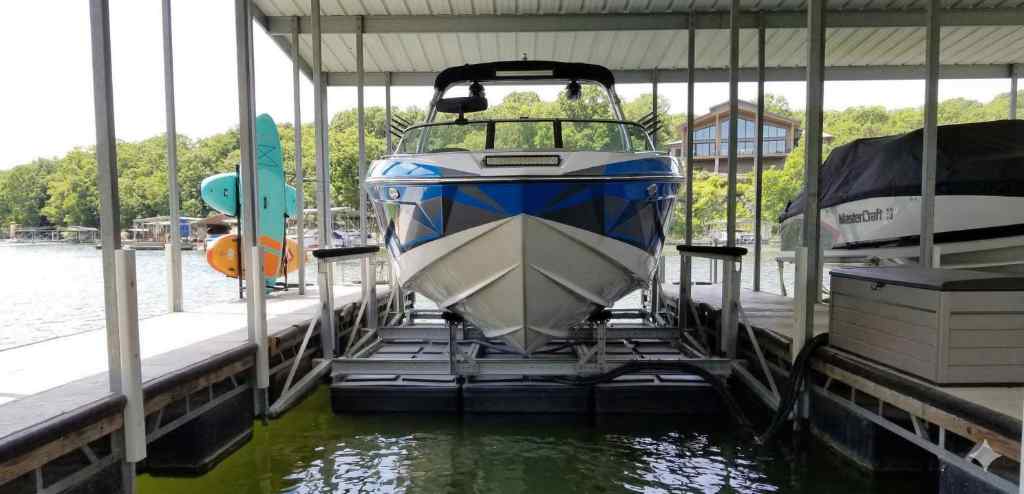
A wake boat centered on a floating boat lift designed for shallow water docks at Lake of the Ozarks.

Shallow Water Boat Lifts: What’s the Best Choice?

Shallow water boat lifts and docks are fairly common at Lake of the Ozarks, especially in coves where the water gets very low during drawdowns. Choosing the wrong boat lift for shallow water can lead to grounding, poor alignment, or usability problems.

This guide will help you understand which boat lift solutions work best in shallow water conditions. If you’re still exploring how different lift systems work, our guide to boat lifts explained covers the major lift types and how they protect boats and docks.

At Lake of the Ozarks, shallow-water docks are especially common in protected coves where the shoreline slopes gradually. Seasonal winter drawdowns can lower the lake level significantly, reducing water depth around many boat slips. Because of these changing conditions, boat owners often need shallow water boat lifts that can continue operating safely even when water levels fluctuate.

Challenges of Shallow Water Boat Lifts

Shallow water presents several challenges:

  • Limited clearance for fixed systems
  • Greater impact from water-level changes
  • Dock movement during drawdown

These conditions require lifts that can adapt—not fight—the environment.

Why Floating Boat Lifts Excel in Shallow Water

Floating boat lifts are often the best solution because they:

  • Require minimal depth
  • Rise and fall with water levels
  • Reduce bottom interference
  • Work well in seasonal low-water conditions

They are especially effective in protected or gradual sloped coves and covered slips.

A shallow water boat lift integrated with a floating dock.
Low-water floating boat lifts work perfectly in a covered boat slip.

Fixed Lifts in Shallow Water: What to Watch For

Traditional fixed lifts may struggle in shallow water due to:

  • Limited adjustment range
  • Risk of grounding during drawdown
  • Increased maintenance and repositioning

In many shallow-water locations, fixed systems are simply not practical.  Traditional fixed boat lift systems (such as bottom-standing vertical lifts with pilings/legs anchored to the lakebed, cantilever lifts, or certain cable-driven designs) are often not practical or face significant limitations.

  • Regulatory standards, such as those established by the Department of Natural Resources, generally identify three feet as the minimum functional depth for traditional boat hoists. Operating in shallower water not only risks equipment damage but can also negatively impact the lakebed’s ecosystem.
  • Shallow areas often have soft or silty bottoms that can’t support leg-based structures. This leads to uneven settling, structural instability, and long-term frame damage.
  • Fixed lifts lack the flexibility to handle tides or seasonal water level changes. Without major mechanical adjustments, even minor fluctuations can render a stationary lift unusable.
A pontoon boat elevated on a floating lift in shallow water conditions at a Lake of the Ozarks dock.
A tritoon is docked on a shallow water boat lift at Lake of the Ozarks.

Dock Layout Still Matters

Even in shallow water, lift success depends on:

  • Dock stability
  • Slip width and access
  • Boat size and draft

Professional evaluation ensures proper placement and long-term performance. Likewise, poor lift selection in shallow water can lead to grounding issues and alignment problems. Our guide to common boat lift problems explains how to identify and prevent these issues.

Minimum Depth Considerations for Boat Lifts

Even in shallow water, a boat lift still requires enough clearance to prevent the boat hull from contacting the lake bottom during loading. Boat draft, lift cradle height, and slip depth all affect whether a lift will function properly. Floating boat lift systems are often preferred for shallow water docks because they reduce the need for fixed underwater structures and adapt naturally to changing water levels.

While the required depth for many lifts is 36″ to 48″ or more, LOTO Lift’s low-water boat lift operates in as little as 24″ of water. Boat size and weight also affect lift selection, which is why understanding boat lift weight capacity sizes is an important step when choosing the right system and discussing it with a reputable and expert dealer or manufacturer.

This video shows a large floating low-water boat lift for a tritoon. Requiring just 30″ of water to operate, this is a prime example of how boat size and weight impact lift selection.

FAQs

Frequently Asked Questions

Do shallow water docks at Lake of the Ozarks require special boat lifts?

Yes. Many shallow coves at Lake of the Ozarks experience seasonal water-level changes during winter drawdowns. Boat lifts designed for shallow water—especially floating lift systems—help maintain proper clearance and usability even when water levels drop.

The required depth depends on the boat’s draft, the lift design, and dock configuration. Floating boat lifts often work well in shallow slips because they require less underwater structure than traditional fixed lifts. LOTO Lift’s Shallow Model can operate in as little as 24″ of water.

In many cases, yes. Floating boat lifts rise and fall with the water level, making them especially effective in shallow coves where seasonal drawdowns can significantly reduce depth.

Get Expert Advice for Shallow Water Lifts

Boat owners across Lake of the Ozarks rely on floating lift systems to solve shallow-water challenges while protecting their boats from grounding and dock alignment problems.

LOTO Lift specializes in floating boat lift solutions for shallow water docks at Lake of the Ozarks.

Contact us today to find the right lift for your shallow water dock.

Read more from our blog...